IN COE BLOOD

J. Frank Mahill tells a tale:
The August 18, 1949, Alamogordo Daily News ran a biographical sketch of Albert Coe, older brother and cousin of Regulators Frank and George Coe, respectively. The information therein was credited to J. Frank Mahill, Albert Coe’s brother-in-law. In it, Frank made a series of statements about Albert’s life story, some of which were somewhat accurate. The anecdotes have a whiff of family tradition, if not hearsay, but are worth exploration, nonetheless.
One example is that of a deadly shooting that occurred on the Ruidoso, between some Murphy men and Albert Coe’s potato plowing partner Abe King. Accused of being allied with the ‘McSwain’ faction, King was arrested and shot down in cold blood. Albert was given a pass, apparently for minding his own business. Mahill doesn’t say exactly when this happened but the mention of Murphy, McSwain, and murder of lawful prisoners, suggests circa 1878, during the peak of the Lincoln County War.
Was Abe King an unrecorded victim of the Lincoln County War?
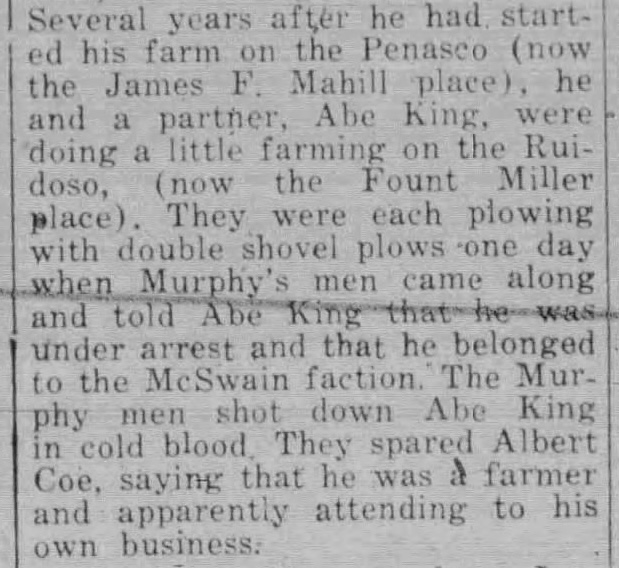
The Mahills did not arrive until after the Lincoln County War, when Albert Coe married Frank’s sister, Mary Mahill, in 1882. Any knowledge Frank had of the killing of King would have been second-hand. And Albert Coe stayed out of the Lincoln County Troubles. He tended to his own business and prospered. There are no other reports of Al being present for a Murphy-McSween shooting scrape. He would have been motivated to stay out of the War. Many of his neighbors, customers, and colleagues were so-called Murphy men, including W. W. Paul and J. B. Mathews. Albert did not have to compete with Murphy and Co. because hay contracts were plentiful. And while his brother-in-law was a business partner and was called ‘Ab’ (Saunders), there is no record of a partner named ‘Abe’ (King). So, while the story seems plausible, did J. Frank Mahill get it right?
George Coe’s version:
There is another Coe family member who tells a similar story about the killing of a man named ‘King’ on the Ruidoso. In his 1934 memoir, Frontier Fighter, George Coe set the scene. In late 1876, the Coe brothers (probably Frank, Louis, Albert, Jasper and Ab Saunders) were partners and were renting a farm on the Ruidoso. Albert also had a homestead up on the Penasco and held hay contracts with Fort Stanton. They had some of the best farming implements in the county and were positioned to make good profit. They hired Cousin George to harvest the potatoes while they attended to work on other ranches. George in turn, hired an old Forty-Niner named Tom King, to help with the double-bladed shovel plows. Coe described King as a ‘freak,’ who had the annoying habit of ‘goosing’ people. One night at a local dance, King made the fatal mistake of ‘goosing’ one of the attendees.
“He poked a long, lean finger at the girl, and gave a catlike yell. It created a panic all right. Her partner flew at him in a rage, but bystanders separated them, and to all appearances the incident was closed. A few days after this, we were working in the potato patch when I looked up and saw the irate cowboy of the party approaching King. I started toward them, and asked ‘What’s the trouble now?’ ‘It’s none of your damned business,’ the fellow replied with considerable emphasis. ‘Do you want any of it?’ I assured him that I did not. He then cracked down and killed the old fellow without further parley, and everlastingly ended his ‘goosing.’” – Frontier Fighter
In George Coe’s version, ‘Abe’ King is ‘Tom’ King, a laborer, not a partner. The time is late 1876, after George’s first season in Lincoln County, before the War-proper began. There’s no word about Murphy men, McSwain, or any arrests being made, only insults followed by premeditated vengeance. King is not described as allied with one side or another, he was just a laborer and the perpetrator of a rude prank.
Something both versions have in common is the talk about business. In Frank Mahill’s account, Albert Coe was spared because he was “tending to his own business.” In George Coe’s account, the cowboy says it was “none of [George’s] damned business.” The Coe family member featured in both versions survived the encounter because they minded their own business. Business may well have been discussed the day King was killed.
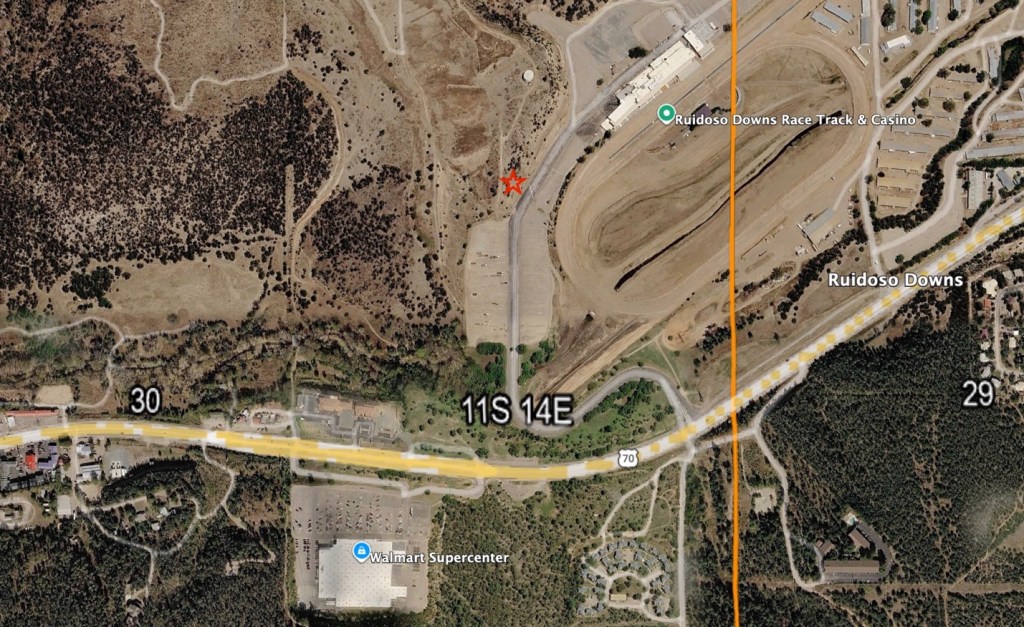
Another commonality is that both accounts name the Ruidoso as the location of the affray, specifically, on the Dowlin property. Coe described it, “just below what is now Hollywood on the Ruidoso.” In fact, it was just around the western perimeter of the modern racetrack at Ruidoso Downs, across the street from Walmart. In 1876, this property belonged to Paul Dowlin and was rented out to the Coe brothers. At the time of the King incident, George had been hired by his cousins to work the land.
Below: An 1867 survey of the area in question. Irrigation, cultivation, and a ranch building are present in the northeast quarter of section 30 in Township 14 north and range 18 south. Paul Dowlin filed a patent on this land in 1879, after years of improvements. He improved much of the local land, owned the mill upriver and was post trader at Fort Stanton, along with his partner John C. Delaney. In 1876, Dowlin leased it out to Albert Coe and his brothers. In 1877, George himself would go on to rent the same land again, which is where he and Billy Bonney bunked up for the winter.

Below: Google Earth satellite image of the same Dowlin property rented by the Coes in 1876-77. The red star is the approximate location of the ranch building present in the 1867 survey. Was Thomas King buried somewhere around here?
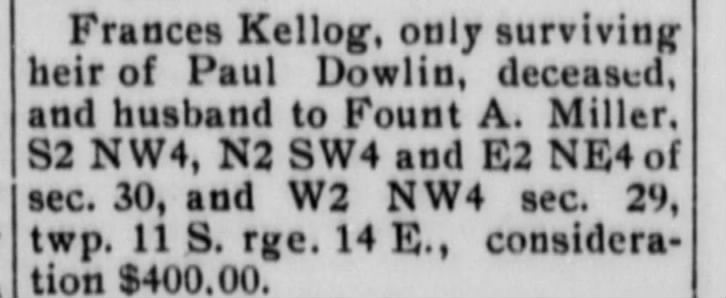
Below: Carrizozo Outlook Friday, March 11, 1910. Page 12. Corroboration of Frank Mahill’s claim that the Dowlin property (where King was killed) was the same as the Fount Miller place. Dowlin filed a patent on this property in 1879.
The context in which George tells his story about Tom King is his acknowledgement of the various neighborhood factions (Anglos) at that time: the Lincoln people, the Penasco people, and the Ruidoso people. Scurlock, Hurley, Mathews, Bowdre, Freeman and Coe, could all hang out and work together as neighbors. In 1876, the hyper-partisanship had yet to tear the community apart. They all got along well enough, but tensions were on the rise. In this setting, the fact that George does not name the cowboy with the itchy trigger finger, who brought down Tom King, seems like a significant omission. In fact, once it becomes clear who exactly shot Tom King, George Coe’s avoidance of naming the perpetrator might seem odd to the 21st century historian.
The Las Vegas Gazette and The Santa Fe New Mexican wrote stories:
Fortunately, the killing of Tom King made it into the papers. And while the accuracy of the reporting cannot be verified, more details about the circumstances do emerge; including who shot King. The Las Vegas Gazette of December 23, 1876, reported that on Friday, December 1, Thomas King was killed “at the farm of Mr. Coe about 20 miles south west from Fort Stanton,” by neighbor William Campbell.
Below: Las Vegas Gazette. December 23, 1876. Las Vegas, NM. Page 2. This article places Campbell’s killing of King on the Coe farm.

No specific mention of George or Albert here, just a ‘Mr. Coe’ reference. King is said to have been working with women, while a second man is reported to have accompanied Campbell. After arguing, Billy Campbell drew and fired, killing King instantly. The very next sentence says multiple rounds were fired, which might suggest overkill.
Meanwhile, a December 14 letter-to-the-editor was printed in the December 23 issue of The Santa Fe New Mexican, which took a very different angle on the murder. First, it made no mention of any Coe, but it did name Campbell’s companion; an ‘L.S.’ or ‘I.S.’ Tesson. The letter also placed the date of the event on December 6 instead of December 1. And while the Gazette decried the lack of arrests and demanded investigation, the New Mexican said only that Campbell was accused of self-defense. The Ring-friendly newspaper held its criticism for the accompanying legal machinations, rather than the crime itself. Justice of the Peace J.B. Wilson was the singular focus of the New Mexican’s microscope.
Below: This December 23, 1876, Santa Fe New Mexican article throws a lot of shade at John B. Wilson. The sarcasm unmistakable.
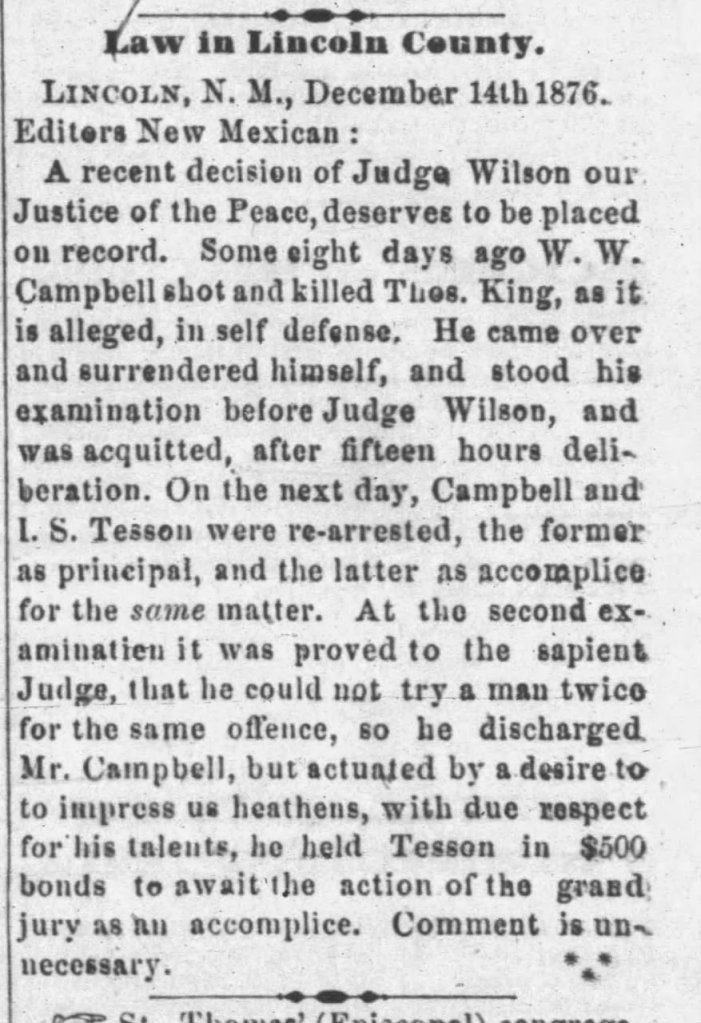
No doubt, Wilson’s brand of jurisprudence was being called out here. Throughout the territory, John B. Wilson had detractors for his unconventional legal maneuverings. The New Mexican jumped at the opportunity here. To indict a man twice for the same crime was one thing; double jeopardy, in fact. But to indict this man Tesson as an accomplice to a crime for which the accused had already been acquitted was beyond the pale, as far as The New Mexican was concerned.
The New Mexican’s take on King’s death seems to have had the most influence on the history. Fulton’s History of the Lincoln County War has a whole paragraph dedicated to the legal machinations after Campbell’s killing of King. Like the New Mexican, the subtext is more of a comment on what justice looks like under J.B. Wilson, and not a focus on the crime itself. Notably, Coe is not mentioned. But, “King’s impoliteness to a certain young woman whom Campbell had gallanted to a dance,” is given as the reason for the difficulty in the first place. This information is not in the New Mexican article, and Fulton/ Mullin did not provide a source. It supports Frontier Fighter’s version of events, but why not mention Coe, if he or The Gazette had been the source? Did Fulton have another source for this story? That remains unknown.
In “Rise of the House of Murphy,” Philip Rasch dedicated a single sentence to the double acquittal of William Campbell, as an illustration of the calm before the storm that was to be the Lincoln County War. He made no mention of a Coe family member either, or a Coe farm. Had Rasch known that a Coe was involved, he probably would have acknowledged it. Rasch also did not cite his source for this story, but presumably it was the December 23 New Mexican article, which made no mention of a Coe. And like the New Mexican, he focused on the issue of double jeopardy, which along with Campbell’s presence, was what made the King murder seem significant to the author, not the presence of any Coe.
Similarly, even contemporary authors David Thomas and James Mills echoed The New Mexican’s version of events in their books, The Trial of Billy the Kid and In the Days of Billy the Kid, respectively. Campbell shot King, followed by farcical wheels of justice. The Coe connection to the King murder seems to have gone unnoticed.
Campbell was a bad dude:
Billy Campbell has a reputation as one of the most fearsome bad guys of the Lincoln County War ensemble. Robert Utley described him as “fierce-looking… ill-tempered, and thoroughly mean.” His violent outbursts frightened his companions. Campbell is most well-known for killing Susan McSween’s lawyer, Huston Chapman, in February of 1879. It was a despicable assassination in every telling, and it was the final nail in the coffin of any hope for legal vengeance for Mrs. McSween.
Campbell’s modus operandi was having the final word by telling his victims off, then filling them with holes. It was consistent in both the 1876 murder of King and the 1879 Chapman murder; there was an argument, then shots. Overkill was present in both murders. King was reportedly shot multiple times, while the one-armed and unarmed Chapman was reportedly burned, either by accelerants or ignition by muzzle flash. The Thomas King murder elevates Campbell’s already elevated reputation as a bad man. And like the Chapman murder, it serves as an example of his apparent untouchable nature when it came to avoiding legal consequences for his death-dealing.
In Authentic Life of Billy the Kid, Pat Garrett said that, at the time of the Chapman murder, Campbell was an employee of James Dolan, having just driven a herd of stock up to Carrizozo. Other accounts say he was a cowpuncher for Ring-master Tom Catron. At times referred to as ‘Tom’ Campbell, Emerson Hough suggested he was a Texan named Ed Richardson. Philip Rasch offered another tradition that his name was Hines. Whatever his name and nativity, his reputation seems to have outweighed his actual role in the larger Lincoln County War. It was the cruelty of the Huston Chapman murder and its practical effect on the happenings of 1879 that put Billy Campbell on the map. Aside from the killing of Chapman and the sequence of events that immediately followed, there is little record of William Campbell and his relationships with other participants of the War. This is what makes Frank Mahill’s account stand out. Even though it is inaccurate, when scrutinized with the newspaper and other Coe accounts, it highlights the murder of Tom King and helps flesh out an underreported and arguably forgotten early encounter between two major names in the Lincoln County Pageant: Coe and Campbell.
Frank Coe’s final thoughts:
There was one other source who gave an account of a shooting involving Billy Campbell and a Coe family member. In Saga of Billy the Kid, Walter Noble Burns quoted Frank Coe as misidentifying Billy Campbell (it was ‘Dutch’ Charley Kruling) as someone shot by George Coe at long range. “George… was a crack rifle shot and… he broke Campbell’s leg.” (Truth is, even George Coe got his name wrong, calling him ‘John Curling,’ in Frontier Fighter). This event took place in Lincoln, at the Ellis place, in the immediate aftermath of the April 29, 1878, Fritz Ranch ambush by Seven Rivers Warriors. Frank McNab had been killed, Frank Coe taken prisoner, and Ab Saunders, Jasper Coe’s brother-in-law, was seriously wounded. Frank Coe went so far as to place Campbell (again, it was Kruling) with Saunders at Fort Stanton, after the skirmish, quarrelling in the post hospital. Ab Saunders would never fully recover from his wounds and in 1883 he died during related surgery. Given Frank Coe’s intimate involvement in these events, it is surprising he should erroneously use Campbell as a placeholder for Kruling. Did Frank Coe mix up Campbell’s role in the 1878 Bonito shoot-out with the 1876 shooting on the Ruidoso, simply because George Coe was involved in both?
Similarly, Frank Mahill’s second-hand version might be a composite of these two events. Although he also didn’t name the ‘Murphy man’ in question, Mahill correctly identified which side of the Lincoln County War the shooter fell on. Partisanship was a factor in the Bonito shooting, while not necessarily in the Ruidoso one. Mahill also seemed to confound the names of the victims of both events, ‘Ab’ Saunders, partner of the Coe brothers, became ‘Abe’ King, partner of Albert Coe. Easy to imagine details from two different stories within a family tradition being melded together over years of retelling. But that is pure conjecture.
After reading the newspaper and anecdotal accounts, it is still not 100% clear which Coe family member was present for the death of Thomas King, although it was probably George. And while Billy Campbell was named in the papers, George did not name King’s killer in Frontier Fighter. In fact, Billy Campbell does not appear in Frontier Fighter, at all. When George Coe writes of the Huston Chapman murder (which George was not present for), he neglects to mention Campbell and names Jack Long, Dolan’s future best man, as the shooter in his stead. Perhaps it was obfuscation or perhaps he simply forgot. Or perhaps George wasn’t there and the story is borrowed from another family member. Or perhaps the Coes did not know Campbell, and the presumption that they should have, is a 21st century bias. What really happened in December of 1876 on the Ruidoso, and who really was there, remains unknown.
A reasonable summary is that on December 1, 1876, Billy Campbell and man named Tessen were looking to burn some gun powder after a perceived slight to Campbell’s girl at a recent neighborhood dance party. The two men rode onto the Coe farm, about a mile below Dowlin’s Mill. They wanted Tom King. Campbell threatened George Coe to mind his own business. And after a brief shouting match, Campbell shot King dead.
July 31, 2026
Sources:
Alamogordo Daily News. Thursday, August 18, 1949. Page 1.
Carrizozo Outlook. Friday, March 11, 1910. Page 12
Las Vegas Gazette. Saturday, December 23, 1876. Page 2.
Santa Fe New Mexican. Saturday, December 23, 1876. Page 1.
Burns, Walter Noble. The Saga of Billy the Kid. Stamford, Connecticut: Longmeadow Press, 1992 (Originally published: New York: Doubleday, 1925.)
Coe, George C. Frontier Fighter. Chicago, Illinois: Riverside Press, 1934. (Originally Published in 1934)
Fulton, Maurice G. History of the Lincoln County War. Edited By Mullin, Robert N. Tucson, Arizona: University of Arizona Press, 1968.
Garrett, Pat F., annotated by Nolan, Frederick. The Authentic Life of Billy the Kid (Annotated Edition). Norman, Oklahoma: University of Oklahoma Press, 2000.
Hough, Emerson. Story of the Outlaw: A Study of the Western Desperado. Mineola, New York: Dover Publications, Inc., 2011. (Originally Published in 1907)
Mills, James B. In the Days of Billy the Kid. Denton, Texas: University of North Texas Press, 2025.
Rasch, Philip J. Gunsmoke in Lincoln County. Edited by Robert K. DeArment. The National Association for Outlaw and Lawman History, 1997.
Thomas, David G. The Trial of Billy the Kid. Las Cruces, New Mexico: Doc45 Publishing, 2021.
Utley, Robert M. Billy the Kid: A Short and Violent Life. Lincoln, Nebraska: University of Nebraska Press, 1989.
Google Earth
Blm.gov

