ESCAPE FROM ALAMO CANYON
The Death of Tom Hill and the Survival of Jessie Evans
Part 1: Alamo Canyon
In March of 1878, Jessie Evans and Tom Hill were on the lookout. They had both ridden with the Sheriff’s posse that trailed and shot dead capitalist and House-rival John Henry Tunstall on February 18. Following his killing, opposing factions of deputized citizens chased, threatened, and harassed each other throughout Lincoln. Evans and Hill would have had something to fear from a group of armed Tunstall allies with badges and personal vendettas. While neither of the ‘Boys’ were legal members of the February 18 sheriff’s posse, they were certainly in on the action. Tom Hill (aka Tom Chelson) was the man most identified by fellow posse members as having delivered the kill shot to the back of Tunstall’s head.
On March 9, the Regulators exacted sickening revenge, killing Buck Morton, Frank Baker, and William McCloskey in Blackwater Canyon, at a place that would from then on be known as “Deadman Canyon.” And while Gov. Axtell would nullify the Tunstall-McSween men’s warrants and appointments the same day, it would not stop the killing spree. Word was getting around and having read the writing on the wall, the Murphy-Dolan men started to skin out.
Over the following weeks, J.J. Dolan skipped up to Santa Fe to nurse a broken leg, reportedly received the week before in a fall from a horse. There he joined L.G. Murphy, who was already trying his hand at convalescing in the Ancient City. The Seven Rivers Warriors headed back to the Pecos where eventually they would receive word of the Regulators’ activities and threats. DA Rynerson and Judge Bristol were also heading for the hills. The two white-collar Ringites, along with Dona Ana County Assessor and future defense lawyer for Jessie Evans, William T. Jones, embarked on a well-timed elk hunt above the San Nicholas Spring, in the San Andreas Mountains. Rynerson and Bristol’s professional status and conspiring guidance over recent court proceedings in the Fritz Insurance case, had set the trap that ensnared McSween and Tunstall.
According to a March 23 Mesilla Valley Independent article titled “The Hunting Party,” the three lawyers spent a week in the mountains and did very little hunting. Aside from a bit of prospecting, they instead climbed the high ridge over their camp. There they stood sentinel and scanned the eastern horizon, watching and waiting.
“The snow-crowned peaks of the Sierra Blanca and the Sacramento mountains… the frowning mouth of the famous Dog Canyon, the Alamo and La Luz, and even the village of Tuleroso (sic), forty miles away were plainly to be seen.”
This article is remarkable in that it illuminates a part of Rynerson’s personality: his preoccupation with Hell. The correspondent describes the three men devoting “the balance of [a] day to reading Henry Ward Beacher’s last sermon on hell.” It was only a few weeks before this, that an inebriated John Riley left a personal correspondence from Rynerson in the home of Alex McSween. In the February 14th letter- only four days before Tunstall’s murder- Rynerson encouraged Dolan and Riley to make it “hot for them all the hotter the better, especially is this necessary now that it has been discovered that there is no hell.” This was probably a reference to fashionable sermons of the 1870s by preachers like Henry Ward Beacher and Robert Green Ingersoll. The message that forgiveness was the only consequence for sin, apparently resonated with Rynerson.
Meanwhile, across the flats, in the Sacramentos, Jessie Evans and Tom Hill would have been keeping a low profile, too. Hiding out might be more accurate. Where? We can only speculate. They had many friends in the neighborhood. Fellow Texan and Banditti George Davis, alias, Jesse Graham, had a place in the Sacramentos on the Tularosa side, near the Rinconada and the Agency, according to George Coe in Frontier Fighter. They also had allies near Elk Springs, on the Penasco, and most likely had access to other unknown destinations to lie low. Having been involved in Tunstall’s death, they might’ve been particularly motivated to steer clear of the Regulator’s whirlwind. But by March 14, they were out and about, harassing settlers, diverting acequias, and breaking into wagons. Maybe they heard about the massacre at Blackwater. Maybe they were looking for cash to get out of town. We can never know.
Sheep herder John Wagner was driving 4,000 sheep from California to Concho County, Texas, and stopped to water his flock at Alamo Canyon, a few miles SE of present-day Alamogordo. It was the best water in the neighborhood which was cris-crossed with acequias and irrigation. Wagner wrote a letter from Tularosa on March 14, 1878, to Probate Judge H.J. Cuniffe. In it, he complained about assaults upon himself and a few locals by “Texans.”
Mr. Cuniffe:
Albino Carrio begs me to inform you that a band of Texans tried to drive him from his ranch and are taking away his water where he is irrigating and they have shot at him. Yesterday they stole a horse from me, broke open my trunks taking out all clothing and throwing it around, built a fire under my wagon, shot my driver in the leg, and took several articles from the wagon with them. Therefore we beg you for assistance.
John Wagner
Wagner’s letter was printed in the March 16, 1878, edition of the Mesilla Valley Independent. In the paper, the details are confused, and both Evans and Wagner are erroneously reported as killed. The March 23 edition of the paper corrected some of the errors and offered a few more clues. It said that Evans was injured, but escaped, and that Hill was “dead and buried.”
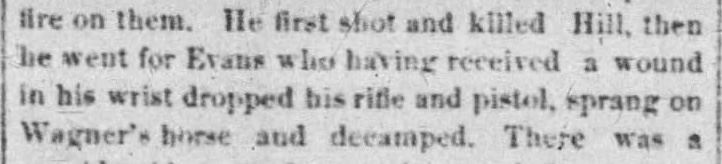
What we can glean is that Evans and Hill attempted to rob the camp while it was mostly unattended. Terms like “band” and “in force” suggest that there may have been more Banditti than just Evans and Hill present. A close reading suggests there was an initial encounter that included the harassment and robbery, presumably followed by Wagner going to Tularosa for assistance, when he wrote his letter to Cuniffe. Sometime after this or possibly at the same time, a second encounter, not mentioned in Wagner’s letter, occurred at Wagner’s wagon. A Cherokee driver of Wagner’s managed to sneak up and get the drop on the two Banditti, killing Hill with a rifle shot through the chest. Evans was hit in the arm but managed to mount Wagner’s horse and escape.
Some 20th century accounts, (all of which seem to trace back to Emerson Hough’s 1907 Story of the Outlaw), claimed that it was Hill’s own rifle that the Cherokee picked up to open fire on the Banditti. If that were the case, it might be said that Tom Hill was killed by his own gun; the same gun that killed Tunstall. According to the Angel Report, most posse members identified Tom Hill as having fired the kill shot to the back of Tunstall’s head with a rifle or carbine.
The chest-shot Hill received is consistent in most tellings. Frederick Nolan put it eloquently when he said Hill was shot “stem to stern.” John Meadows put it graphically when he said Hill’s spine was blown to pieces. The Independent gleefully pointed out that Hill was “dead and buried.” This can lead one to wonder, where? It’s worth noting that there is a place called Deadman Canyon that intersects with Alamo Canyon, just at the latter’s mouth, where the events were said to have transpired. As can be seen in Blackwater Canyon, where Deadman Canyon is named for men being killed and buried there, it’s reasonable to suggest Tom Hill is likewise buried at Deadman Canyon in Alamo Canyon.
Part 2: Trail of Blood
The extent of Jessie’s injuries is not clear, but he was almost certainly shot somewhere in the left arm. On March 23, 1878, the Mesilla Valley Independent described the wound at the wrist.
The April 6 issue of the same paper also identifies a wound on his wrist.
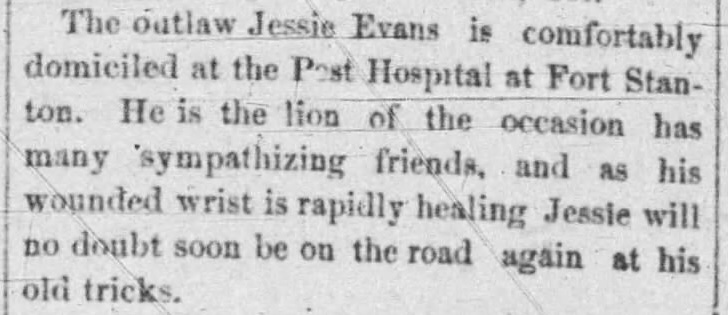
Ed Bartholamew’s 1955 Jesse Evans, a Texas Hide-burner highlights Huntsville Prison records from Jessie’s 1880 incarceration. To wit, a physical description of his scars being two on the left thigh, (presumably from a January 1878 gunshot received while stealing mules off the Mimbres), and one above and one below the left elbow, said to have been suffered at Alamo Canyon when Hill was killed. Below the elbow might well include the wrist.
20th century accounts of the Alamo Canyon raid often included the additional detail of Jessie having taken a shot in the lungs . This researcher can find no contemporary 19th century evidence to support this. The earliest the account of a lung shot can be found is again traced to Emerson Hough’s 1907 Story of the Outlaw. It was later parroted by Walter Noble Burns and repeated by Maurice Fulton right down to Frederick Nolan and beyond. None of those authors cited the source for that story. That’s not to say the intel Hough got wasn’t accurate, only that there is no forthcoming 19th century account of a lung-shot Jessie Evans. Nor are there any requisite scars mentioned in the 1880 Huntsville Prison record to support a bullet wound to the lung.
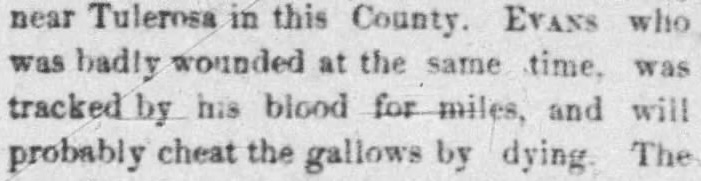
While he was certainly hurt, whither did Jessie ride? The accepted version of his escape is that the bloodied Jessie Evans rode 50 miles southwest across the Tularosa Basin to Shedd’s San Augustin Ranch to seek succor amongst allies. Somewhere along the way or at the ranch itself, as the story goes, Deputy David Wood arrested Evans and delivered him to Fort Stanton.
Once again, this tradition has provenance only in Hough’s Story of the Outlaw. This researcher can find no contemporary 19th century evidence for this sequence of events. Not to say Hough’s source was wrong, but the fact that it was written 25 years later, should be accounted for. Eroding this narrative’s dependability is the fact that Hough also confuses timelines between Jessie’s 1878 confinement at Fort Stanton with his 1879 confinement and escape after the Huston Chapman murder.
The theatrical getaway by Evans led some 20th century researchers to go so far as to suggest that the Alamo Canyon raid took place at a totally different Alamo Canyon; one in the San Andreas Mountains, instead of the one in the Sacramentos. This comes up in Jessie Evans: Lincoln County Badman, by Grady McCright and James Powell. They suggested that the 1878 newspapers were wrong in saying Evans rode in the direction of the Rio Penasco. Their speculation being motivated by the need to reconcile how a supposedly lung-shot and arm-shot and 2-month-healed groin-shot Jessie Evans ended up 50 miles across the salt flats at Shedd’s Ranch, as portrayed by Hough. The 50-mile ride seemed improbable enough that they chose a completely new location for the raid to have occurred. They believed Hough’s account of twenty-nine years after the fact over the Messila Valley Independent’s reporting of one week after.
It should be said that some believability of Hough’s version is reinforced by the fact that David Wood, whom he gives credit for Evans’ arrest, would eventually be associated with the San Nicholas Spring, which was in close proximity to Shedd’s Ranch. They were, for all intents and purposes, a waystation away from one another on the road between San Augustine Pass and Tularosa.
In the mid 1870s, David Wood had beef contracts with Fort Seldon. Knowing the practices of government beef contract procurement of the time and place, it stands to reason that Wood may have bought stolen stock on occasion. By the same reasoning, he had not a small chance of being on friendly terms with the Boys and Banditti, regardless of whether he was at San Nicholas in 1878. There is a lack of documentation of Wood at San Nicholas before the 1880s.
Below: Abstract of beef bids for District of New Mexico. Santa Fe Weekly New Mexican, Thursday, April 18, 1876, page 1

In the fall 1877, Richard Brewer, Charlie Bowdre, and Doc Scurlock, trailed stolen ponies to both San Nicholas and Shedd’s Ranch. The two ranches were close to each other, and over the years both served as pens for stolen stock. In March of 1878, San Nicholas Spring was, according to the Mesilla Valley Independent, still a known rendezvous of the Banditti. Billy Bonney would later echo this characterization in an 1879 letter to Gov. Lew Wallace, saying that San Nicholas was a place used for hiding stock by Banditti ally Jim McDaniels.
Only in the 1880s, however, did Wood officially become associated with San Nicholas Spring. A 1967 Real West Magazine article written by Wood’s granddaughter, Eileen Hunt, suggested that the Wood family were living at San Nicholas Spring in April 1881, when the entourage bringing Billy Bonney to Lincoln for execution stopped for the night. This anecdote is the earliest claim this researcher has seen of Wood’s association with San Nicholas. He was deputized at the time. Certainly by 1882, Wood and partner, Daniel Reade, were running ads for Jacks and Jennies (male and female mules) for sale out of San Nicholas Spring. The area would expand after a small mining boom followed by a small railroad boom and Wood would file a patent on the San Nicholas Spring land in 1890. Eventually it expanded up the Little San Andreas Canyon, and he would become a popular rancher and respected old-timer.
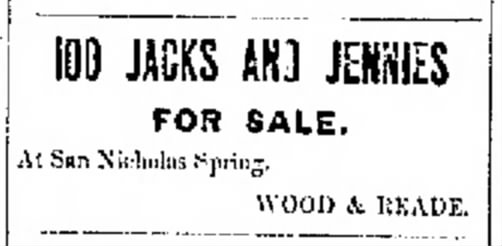
Wood’s relationship with the Boys, the House, and the Santa Fe Ring, if any, remains open for more research. Meanwhile, one might try to speculate that he was in the San Nicholas area in 1878, perhaps conspiring with the “Hunting Party” of Rynerson, Bristol, and future Evans defense lawyer W.T. Jones. There just isn’t any evidence for it.
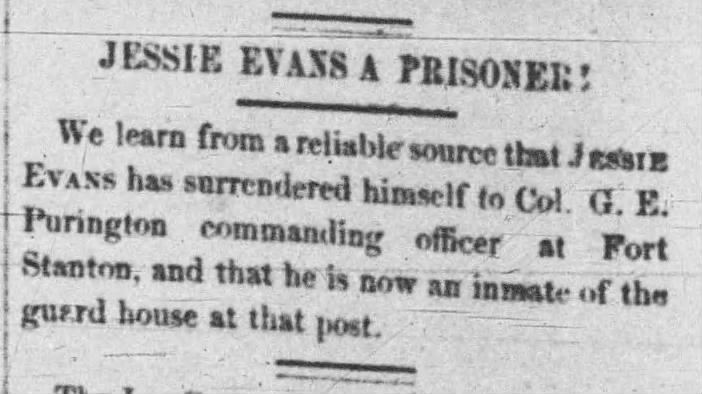
The March 23, 1878, Mesilla Valley Independent article “The Hunting Party” provided a detailed history and description of the San Nicolas Spring. Notably, that San Nicolas Spring “has been one of the many rendezvous of our Dona Ana County Banditti… and as the Banditti were off regulating affairs in Lincoln Co. our trio of hunters had no apprehension of an unpleasant encounter.” No mention of Wood, just an isolated location where one might run into bandits, if not Apache. W.T. Jones, who was likely the Independent’s correspondent for the article, would have passed by Shedd’s on his way back from San Nicholas. He should have gotten wind of Jessie’s situation, had Jessie passed through San Nicholas or Shedd’s, right? For Jones not to publish remarks on Evans or Wood must mean either it didn’t happen, or conspiracies were afoot. If David Wood was responsible for the arrest of Jessie Evans at Shedd’s or San Nicholas, or wherever, in March of 1878, including his delivery to Fort Stanton, it seems less than unlikely that it would not be mentioned in the press. Especially so, in view of the Mesilla Valley Independent’s report on March 30 that Jessie Evans turned himself in at Fort Stanton.
Below: Contrary to the Hough and Burns claims that David Wood arrested him, the Mesilla Valley Independent reported on March 30, 1878, that Jessie surrendered himself to Col. Purington at Fort Stanton.
If Jessie didn’t ride 50 miles to Shedd’s, as suggested by Emerson Hough, where did he go? 19th century newspaper accounts have him traveling east after Hill is killed, not west. The New Mexican has him with allies in the Rio Penasco (east) neighborhood. There are no contemporary accounts of him having gone west. To the contrary, he is reported as giving himself up.
There is one 20th century account that offers an alternative timeline to that of Story of the Outlaw. In Pat Garrett and Billy the Kid as I Knew Them, John Meadows says that after his escape, Jessie “went to Three Rivers near where this friend Felipe Frederick lived in the Nogal Canyon.” Meadows cites Billy Mathews with the story that Evans was picked up in a tram and brought back to the Frederick home in South Fork. Mathews was in an excellent position to know. In fact, if newspaper accounts were any clue, Mathews’ place on the Penasco would have been an excellent place to ensconce Evans, as well as any of his other amigos in the Sacramentos. The Frederick place in Nogal Canyon at South Fork was much closer, however, and a shorter ride to Stanton.
After the events of Alamo Canyon, Meadows’ story realigns with Hough’s and Burns’. Jessie is arrested (although he doesn’t say by whom), confined at Fort Stanton, and just like the Hough and Burns narrative, Meadows skips directly to Jessie’s 1879 escape from Stanton and arrest in Texas, completely omitting Jessie’s July 1878 acquittal of charges in the murder of Tunstall and the 1879 murder of Huston Chapman. What happened to Jessie after arriving at Fort Stanton in late March of 1878 is beyond the scope of this article. But what this shows is that Meadows, if aware of the Burns and Hough timeline, still chose to tell the story of Jessie’s escape from Alamo Canyon differently. Why would he do that? Maybe because he thought he knew the truth.
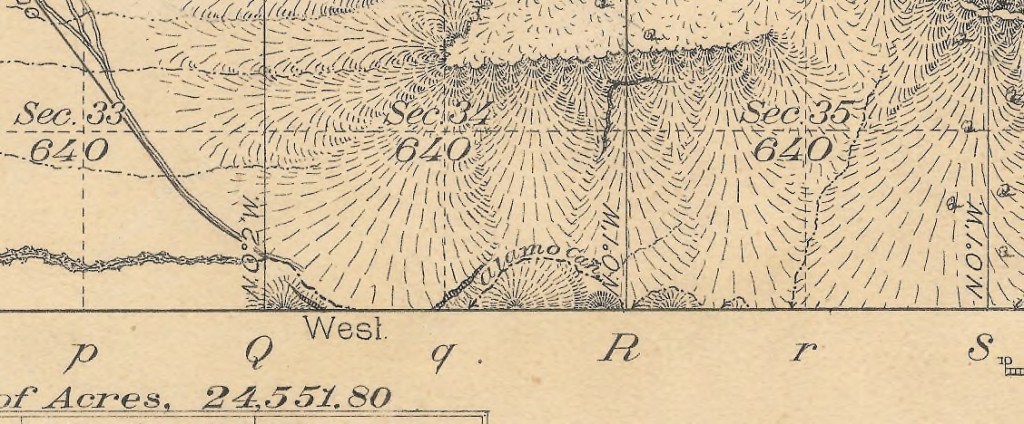
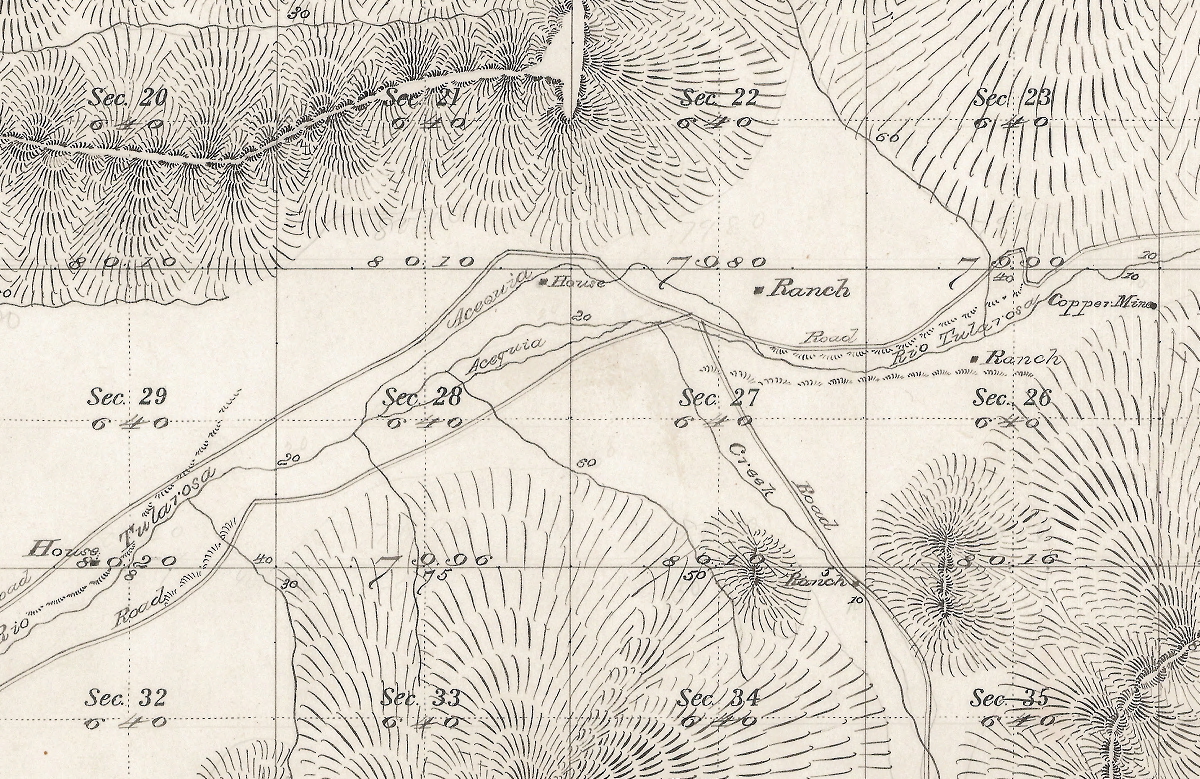
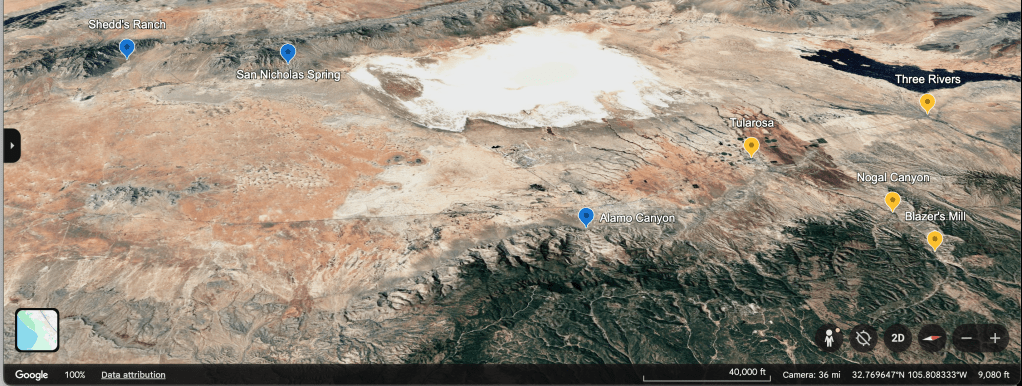
Below: 1883 survey of Nogal Canyon on Rio Tularosa. It was part of the South Fork community near Blazer’s Mill. The South Fork and Nogal Canyon were both access points over the mountains, into the Rio Penasco communities to the southeast.
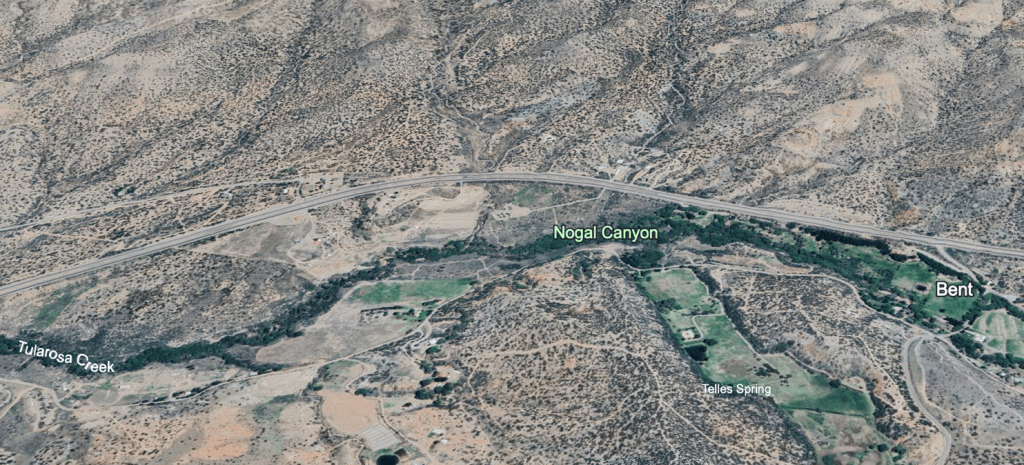
Below: Google Maps and Google Earth satellite imagery of Nogal Canyon and its environs. This is not to be confused with another Nogal Canyon to the north at Nogal Peak, which became well known after mining booms in the 1880s.
Part 3: The Fredericks
Who was Felipe Frederick? Is it possible this game of telephone between Billy Mathews, John Meadows, and modern historians is accurate? There is only one Frederick family this researcher has found in 1870s and 1880s Lincoln County.
The 1880 US Census for South Fork, Lincoln County, NM, lists a 35-year-old farmer named Christian Frederick, along with his wife 40-year-old Annie, and daughter 11-year-old Josephine.

Other documentation revealed his full name to be Christian Philip (Felipe) Frederick(s). Depending upon the document and the time frame, he is sometimes recorded with an S at the end of his last name. Similarly, his middle name and initial has been recorded both as P and Philip or Phillip, as well as F and Felipe. The use of these names and initials varied over the years.
Indexed marriage records show Christian Frederick married Annie Turner in Colfax County, New Mexico on December 1, 1870. This is the earliest record this researcher has found for this man. There is potential 1860s immigration and military documentation but nailing it down to this individual is difficult. The best guess is he immigrated from Germany in the early 1860s, perhaps to Illinois, served in the war between the states, and was naturalized after the war. As is often the case with 19th century census records, some of his biographical information is inconsistent between records. It seems likely that he may have had personal issues worth hiding, and henceforth some of the inconsistencies took on a character of obfuscation.
The 1870 US Census for Elizabethtown, Colfax County, New Mexico lists a 31-year-old Annie M. Turner, a schoolteacher born in Canada, living with a 10-month-old baby Josephine Turner, born in Colorado, and a 10-year-old girl Florence Turner, born in Illinois.

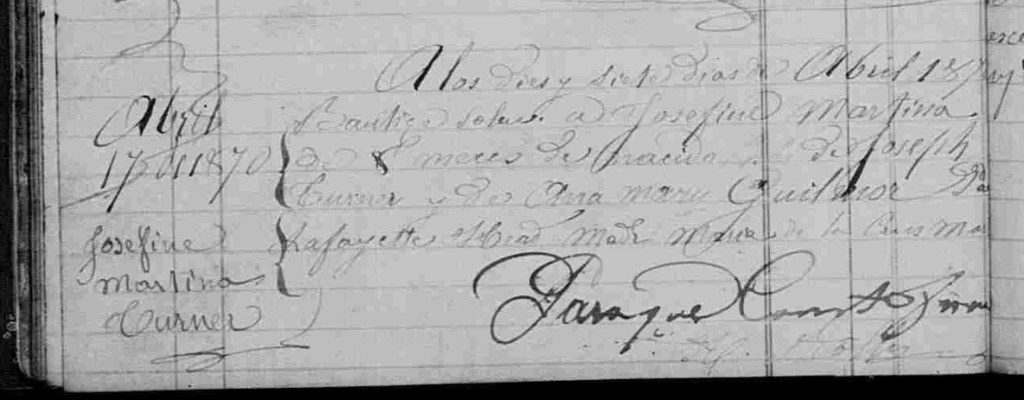
Baby Josephine Turner’s baptism was recorded in the records of the San Augustin Church of Conejos, CO, in April of 1870. Her mother is listed as Ana Guilford Turner. Her father is listed as Joseph Turner.
Below: Josephine Turner’s baptism record. Interestingly, Lafayette Head and his wife Maria Juana de la Cruz Martinez are listed as godparents to Josephine. Lafayette Head was a Ute Indian Agent at Conejos. A Lucian Maxwell-type patriarch to the community, he was an Anglo outsider, who arrived via conquest, married locally, and juggled Spanish Land Grants- not to mention the institution of indigenous servitude. He would later serve as Colorado’s first Lieutenant governor. It’s unclear if his presence at the sacrament bespoke a personal relationship with the Turner family or simply his coincidental proximity. According to Dr. Estevan Rael-Galvez of Native Bound Unbound, Lafayette and Maria Juana were often listed as ‘padrinos’ or ‘godparents’ in church records of the time and place, mostly due to their role as community leaders at the Agency.
This researcher has been unable to find further information about when Joseph Turner died or if the couple were separated. When she remarried Christian Philip on December 1, 1870, Annie, baby Josephine, and young Florence all changed their names from Turner to Frederick. 1870 closes with the newly minted Frederick family, somewhere in Colfax County, New Mexico- probably Elizabethtown.
How and when did the Frederick family go from Colfax County to Lincoln County? Were they in Nogal Canyon in March of 1878? What happened to young Florence and Josephine? And what does it have to do with Jessie Evans?
In the pages of Lily Casey Klasner’s My Girlhood Among the Outlaws, is an anecdote intended to illustrate what a practical joker old Cattle King John Chisum was. As a prank, he set himself up in a love triangle as a rival to one of his employees, cow puncher Jim McDaniels, for the affections of a young girl named Florence Fredericks. Chisum was old enough to be her grandad and claimed he did it just to tease the girl and watch her squirm. When she turned him down in favor of McDaniels, Chisum seemed to delight in torturing Florence’s mother, Mrs. Fredericks, with his lamentations, while she tried to apologize for his heartache.
“Jimmie McDaniels… was courting the daughter of a man by the name of Fredericks, who lived on our lower place… the young woman was fifteen or sixteen… she was very popular. Jesse (sic) Evans, Frank Baker, Marion Turner, and a number of others were in the running.”
The approximate age Lily Casey Klasner gives for Florence Fredericks matches the Florence Turner/ Frederick from the 1870 Elizabethtown census, if we consider the timeframe when McDaniels and Evans were riding for Chisum. If true, this event probably took place around 1875. Klasner mentions Mr. and Mrs. Frederick, as well as Florence, but no mention of Josephine, who would have been 5 or 6-years-old at the time. No other details are offered but the following.
“… She and Jimmie McDaniels did not get married… the girl’s family moved off our place, and she afterwards married someone else.”
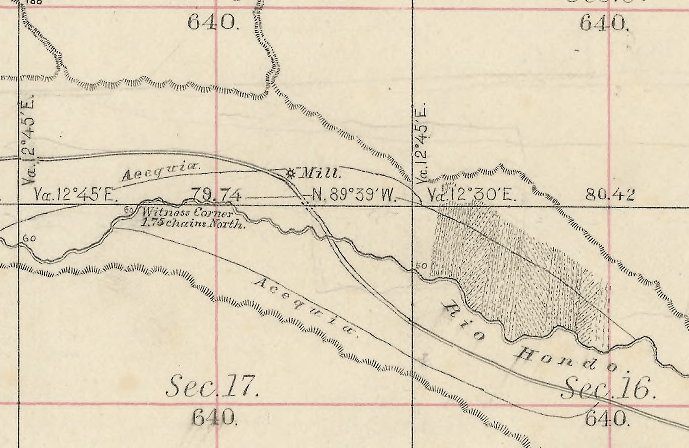
Below: 1881 plat of what was the Casey Mill on the Rio Hondo, circa 1875. If Lily Klasner can be believed, the Fredericks lived in a small adobe that the Caseys rented out to boarders. It was across an irrigation ditch from the Casey residence, about thirty yards north of the mill.
Part 4: Conclusion
The anecdotal evidence provided by John Meadows and Lily Casey Klasner, both independently connect an 1870s Lincoln County family by the name of Frederick(s) with Jessie Evans. Census data, marriage and baptismal records show that this was a real family. The documents also make a strong case, together with the Meadows and Klasner evidence, that the South Fork, Hondo, and Elizabethtown Turner-Fredericks were all the same people.
Meadows’ account could be more accurate than given credit for. The Fredericks appear to have been allies of Jessie and the Boys, according to Klasner. They were local to the shooting affray, as suggested by the 1880 census data. Christian Philip could have easily picked him up at Three Rivers and brought him back to South Fork, as alleged by Matthews, according to Meadows. Annie, Josephine, or Florence could have been there. They could have tended Jessie’s wounds or cooked him some grub. Perhaps one of the Fredericks drove him to Fort Stanton to receive medical care. Perhaps.
We may never know where the perforated Jessie Evans curled up after the death of Tom Hill at Alamo Canyon. But at the very least, this reanalysis of the documentation has reintroduced some forgotten players back into the history of Lincoln County and the Boys. Christian Philip Fredericks and family were a real-life family of pioneers living in Lincoln County at the height of the Lincoln County War.
Part 5: Epilogue
Florence Fredericks disappeared from the record after Lily Klasner’s timeline. Perhaps she went away and got married as described. No telling if she would have been present at Nogal Canyon in March 1878 to possibly aid and shelter Jessie Evans. Maybe.
In 1882, Christian Philip’s mother Rose, his sister Juana, and his future second wife Rosalie Maier, immigrated to New Mexico from Germany, and moved in with Christian Philip. Sometime between 1880 and 1883, he abandoned Annie and Josephine. In 1883, Rosalie and Christian Philip were married in Dona Ana County.
The 1885 New Mexico Territorial Census’ Agricultural Schedule has Christian Fredericks and his new family farming corn and barley in Dona Ana, Dona Ana County. The couple had twins, Lena and John, in 1886, and they would continue to have many children over the next twenty years. In the early 1890s, the family relocated to Albuquerque, where Christian Philip worked as a blacksmith. They would live on Arno Street there until his death in 1915.
Below: 1885 Census for Inhabitants, Dona Ana, Dona Ana County.

Below: Christian F. Frederick appears on the 1890 US Census Veterans’ Special Schedule as still living in Dona Ana. Frustratingly, his regiment is not listed on this form.

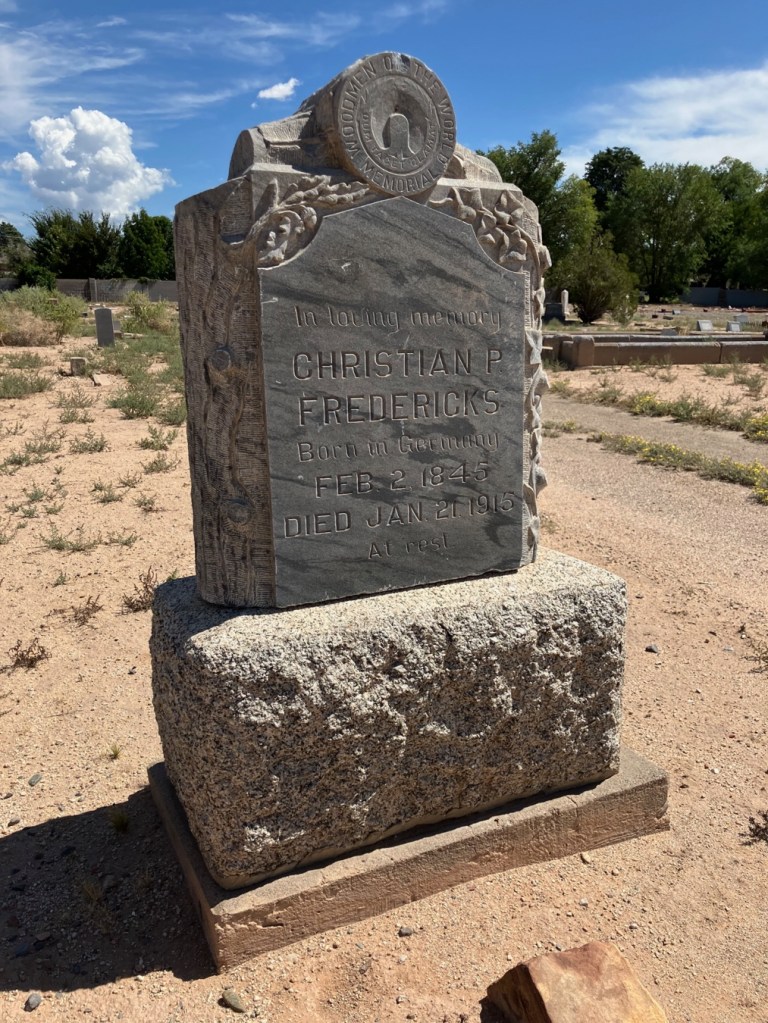
Below: Christian Philip Fredericks’ headstone. Fairview Cemetery, Albuquerque, NM. Rosalie Maier, his second wife, is buried at his side. His mother, Rose Shempp, is buried nearby in an unmarked plot. Photo by the author.
Below: The 1885 Territorial Census shows 45-year-old Annie M. and 15-year-old Josephine are living together in Precinct 10 of Dona Ana County. They hadn’t moved far from South Fork. Instead, their neighborhood became part of Dona Ana County in 1885 when county lines were adjusted. Annie was a teacher again and still using the last name Frederick. Josephine, meanwhile, reverted to using her birth name Turner.

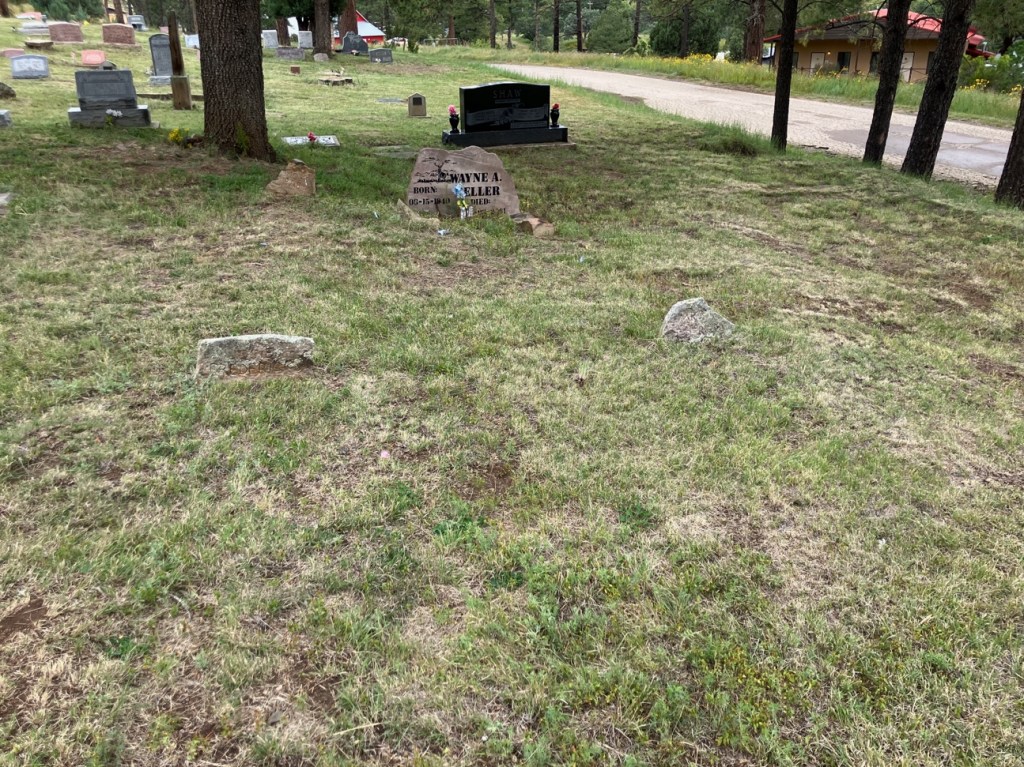
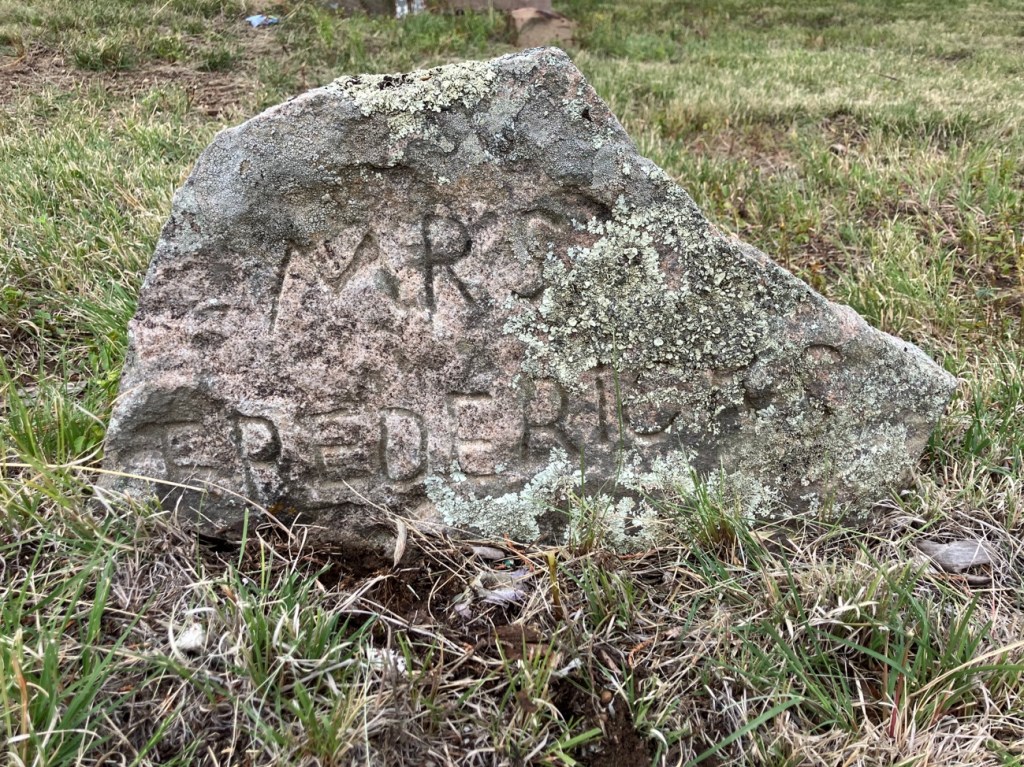
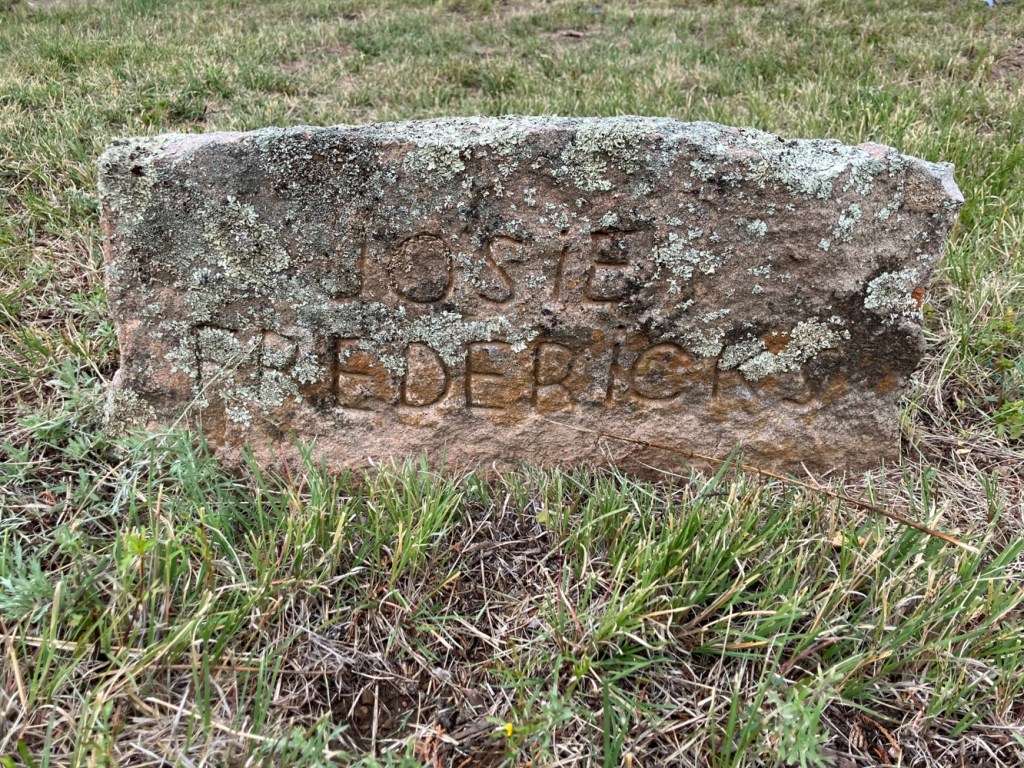
The mother and daughter fell into obscurity after this. They are buried next to one another in the Angus Cemetery in Alto, NM; both under the name Fredericks.
Below: The graves of Annie (Mrs.) and Josephine (Josie) Fredericks at Angus Cemetery, Alto, NM. It is unknown when they died. Cemetery records older than 1951 are incomplete. Photos by the author.
Sources:
Mesilla Valley Independent, Saturday, September 22, 1877. Page 3.
Mesilla Valley Independent, Saturday, January 26, 1878. Page 3.
Mesilla Valley Independent, Saturday, March 23, 1878. Pages 1-3.
Mesilla Valley Independent, Saturday, March 30. Pages 1 and 2.
Mesilla Valley Independent, Saturday, April 6, 1878. Pages 2 and 4.
The Weekly New Mexican, Tuesday, April 18, 1876. Page 1.
The Las Cruces Sun-News, Saturday, December 2, 1882. Page 5.
Bartholomew, Ed. Jesse Evans, A Texas Hide-Burner. Houston, Texas: Frontier Press of Texas, 1955.
Burns, Walter Noble. The Saga of Billy the Kid. Stamford, Connecticut: Longmeadow Press, 1992 (Originally published: New York: Doubleday, 1925.)
Coe, George C. Frontier Fighter. Chicago, Illinois: Riverside Press, 1934. (Originally Published in 1934)
Fulton, Maurice G. History of the Lincoln County War. Edited By Mullin, Robert N. Tucson, Arizona: University of Arizona Press, 1968.
Garrett, Pat F., annotated by Nolan, Frederick. The Authentic Life of Billy the Kid (Annotated Edition). Norman, Oklahoma: University of Oklahoma Press, 2000.
Hough, Emerson. Story of the Outlaw: A Study of the Western Desperado. Mineola, New York: Dover Publications, Inc., 2011. (Originally Published in 1907)
Klasner, Lily. My Girlhood Among the Outlaws. Edited by Ball, Eve. Tucson, Arizona: University of Arizona Press, 1972.
McCright, Grady E. and Powell, James H. Jessie Evans: Lincoln County Badman. College Station, Texas: Creative Publishing Company, 1983.
Meadows, John P. Pat Garrett and Billy the Kid as I Knew Them. Edited by Wilson, John P. Albuquerque, New Mexico: University of New Mexico Press, 2004.
Mills, James B. Billy the Kid: El Bandido Simpatico. Denton, Texas: University of North Texas Press, 2022.
Nolan, Frederick. The West of Billy the Kid. Norman, Oklahoma: University of Oklahoma Press, 1998.
Rasch, Philip J. Gunsmoke in Lincoln County. Edited by Robert K. DeArment. The National Association for Outlaw and Lawman History, 1997.
Rasch, Philip J. Warriors of Lincoln County. Edited by Robert K. DeArment. The National Association for Outlaw and Lawman History, 1998.
Slatten, Josh. “Billy the Kid to Hang” Billy the Kid’s Coalition Press, Vol. 6, 2026. Pages 11-12.
Thomas, David G. The Frank W. Angel Report on the Death of John H. Tunstall. Las Cruces, New Mexico: Doc45 Publishing, 2022.
Utley, Robert M. Billy the Kid: A Short and Violent Life. Lincoln, Nebraska: University of Nebraska Press, 1989.
Ancestry.com. U.S., Select Births and Christenings, 1867-1931 [database on-line]. Provo, UT, USA: Ancestry.com Operations, Inc., 2014.
Ancestry.com. 1870 United States Federal Census [database on-line]. Lehi, UT, USA: Ancestry.com Operations, Inc., 2009. Images reproduced by FamilySearch.
Ancestry.com. New Mexico, U.S., Compiled Marriage Index, 1727-1900[database on-line]. Provo, UT, USA: Ancestry.com Operations Inc, 2005.
Ancestry.com and The Church of Jesus Christ of Latter-day Saints. 1880 United States Federal Census [database on-line]. Lehi, UT, USA: Ancestry.com Operations Inc, 2010
Ancestry.com. New Mexico, U.S., Territorial Census, 1885 [database on-line]. Lehi, UT, USA: Ancestry.com Operations, Inc., 2010. This collection was indexed by Ancestry World Archives Project contributors.
Ancestry.com. 1890 Veterans Schedules of the U.S. Federal Census [database on-line]. Lehi, UT, USA: Ancestry.com Operations Inc, 2005.
Ancestry.com. 1900 United States Federal Census [database on-line]. Lehi, UT, USA: Ancestry.com Operations Inc, 2004.1910
Ancestry.com. 1910 United States Federal Census [database on-line]. Lehi, UT, USA: Ancestry.com Operations Inc, 2006.
Ancestry.com. U.S., Find a Grave® Index, 1600s-Current [database on-line]. Lehi, UT, USA: Ancestry.com Operations, Inc., 2012.
Google Earth Images citation
BLM plats citation
June 25, 2026

